
• Books
  • Bio
  • Resources
  • Contact
Menu

Susan Santone is an educator and author for sustainability and social justice.

  • Books
  • Bio
  • Resources
  • Contact

Here you will find an archive of blog posts.

SJ not controversial short.PNG

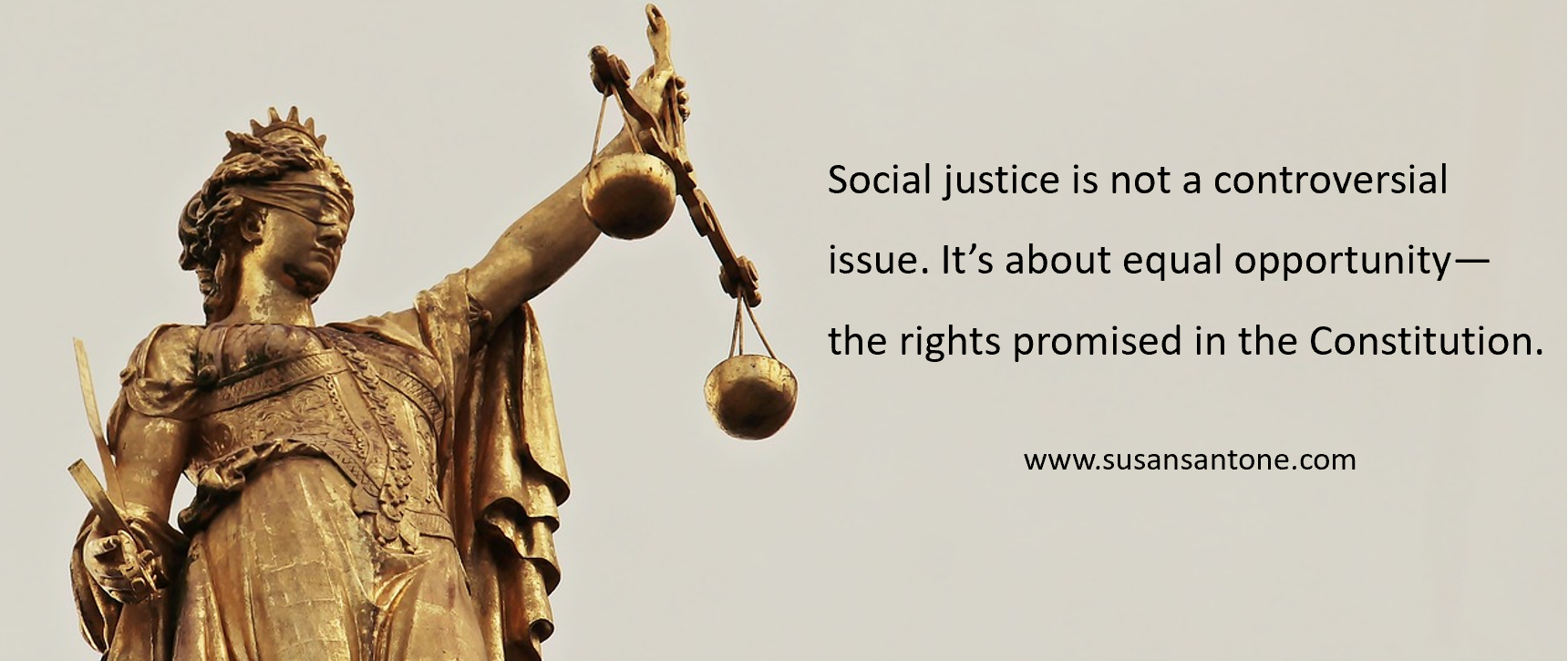
Social Justice: It's democratic (small d), not Democratic

February 27, 2019

“If we advocate for social justice, aren’t we just indoctrinating people? Isn’t that political?”

I hear this question from educators and community leaders who are eager but hesitant to bring a social justice lens to their work.

A key pillar of social justice is equal opportunity. This is not a controversial issue; it’s in the Constitution. Social justice is democratic, not Democratic. Educators and leaders must advocate for equal opportunity; to stay silent or turn the other way is tacit approval for injustice. Likewise, “neutrality” is a myth. The decision about which issues, facts, and perspectives to introduce rests upon values and assumptions. Whose story is presented? Why? What is included or omitted? While we can and must make space for a range of views, we cannot pretend that these views exist in a valueless vacuum.

Advocacy or indoctrination?

But where is the line between advocacy for democratic values and indoctrination? Is facilitating a discussion about a “political” issue the same as "taking a side?" Of course not. But in today's charged climate, this distinction gets lost and people retreat from the challenge of having the conversations society needs us to have. And while it can be confusing to differentiate between advocacy and editorializing, the distinction is critical: The former is a civic obligation; the latter squelches critical thinking. Let me share an example from my own teaching.

On Wednesday, November 9th, 2017 at 9am—just hours after the election of Donald Trump—I walked into my undergraduate Social Foundations of Education class to find most of my students, including three Muslims, looking shell-shocked. One student, a white female, shrugged and said, “Hell, I voted for Trump.”

I neither took a side nor shared how I voted; spouting my views would not have sharpened my students’ critical thinking skills. However, I did not ignore the election on the belief I must be “neutral.” Instead, I did two things: First, I brought the discussion back to the shared values we’d been studying all semester: equity, the common good, human dignity, and the well-being of children. Second, I reminded students of their professional responsibility to stand up for these values. That means considering if or how the new administration would carry out these values through policy and practice. While I clearly took a stand, it was for our civic and educational obligations.

It’s not either-or

Everyone loses when advocating for justice is demonized as a radical agenda. This distortion dissolves what should unite us: the realization that equal opportunity (often framed as a “liberal” goal) enables individuals to reap the rewards or failures of their own initiative (a “conservative” perspective).

There’s nothing ideological about creating fair policies that enable everyone to reach their potential.

Check out my other posts (past and future) for facilitation strategies that develop understanding instead of resistance. Want to swap ideas? Contact me.


Tags social justice, education, democracy
← Clear-cutting the Paper Mache Rainforest and Other Earth Day Teaching IdeasThis MLK Day, Stop Celebrating Diversity and Start Confronting Racism →

Latest Posts

Featured
democratic not Democratic (2).jpg
July 10, 2024
Diversity, Equity, Inclusion and Social Justice Blogs: Quick Links
July 10, 2024

Find my collection of blogs on equity and social justice here.

Read more →
July 10, 2024
Neoliberalism in Education: What you need to know
May 21, 2024
Neoliberalism in Education: What you need to know
May 21, 2024
Read more →
May 21, 2024
Indigenous Language & Values in the Classroom + Home
August 10, 2023
Indigenous Language & Values in the Classroom + Home
August 10, 2023
Read more →
August 10, 2023
Banned Books and Free Speech in Schools: Tips for Teachers, Authors, and Readers
August 5, 2022
Banned Books and Free Speech in Schools: Tips for Teachers, Authors, and Readers
August 5, 2022

Banned books, censorship, and other assaults on free speech in school. What’s a teacher or author to do? In this blog, I discuss two defining legal cases on the topic and offer strategies for defending challenged content.

Read more →
August 5, 2022
How can we improve civic dialog and heal divisions?
July 9, 2022
How can we improve civic dialog and heal divisions?
July 9, 2022

The hard work of becoming informed citizens is a dying art, but we can revive it. The health of our democracy depends on it. Effective dialog is the foundation.


Read more →
July 9, 2022
The Pseudoscience Driving Hate
May 28, 2022
The Pseudoscience Driving Hate
May 28, 2022

While the physical differences we associate with race are real, there is no single “race gene.” Nonetheless, the idea persists, resting upon a troubling yet often hidden history of misusing science to justify social-constructed racial hierarchies.

Read more →
May 28, 2022
New Podcast Episodes
February 28, 2022
New Podcast Episodes
February 28, 2022

What’s more fun than listening to podcasts? Being a guest on one.

I recently had the opportunity to be interviewed on two educational podcasts on the following shows. I hope you’ll take a listen.

Read more →
February 28, 2022
Critical Race Theory and the Race to Silence Teachers
February 8, 2022
Critical Race Theory and the Race to Silence Teachers
February 8, 2022

With the new school year upon us, a growing number of states are in overdrive to ban honest teaching about race, with fears of Critical Race Theory as a flagship motivation. In this post, I dig into the controversy, expose hypocrisy, and share the analysis created by my students at the University of Michigan.

Read more →
February 8, 2022
Yes, you can teach about religion during the holiday season
December 10, 2021
Yes, you can teach about religion during the holiday season
December 10, 2021

It’s December, and that means K-12 students and their families will be celebrating Hannukah, Christmas, and other religious holidays. It also means that school officials wonder if they can discuss religious beliefs, display related decorations, or include sacred music in holiday concernts. This blog offers some answers.

Read more →
December 10, 2021
Economic Growth Fails the Science Test
November 2, 2021
Economic Growth Fails the Science Test
November 2, 2021

Growth is the sacred cow of economic policy, a goal fueled by this unquestioned premise: Unlimited growth is both desirable (because it’s always beneficial) and possible (because nothing can contain human ambitions). It’s an alluring narrative. But do the storytellers realize they’re spinning science fiction?

Read more →
November 2, 2021

Contact


© Susan Santone