
• Books
  • Bio
  • Resources
  • Contact
Menu

Susan Santone is an educator and author for sustainability and social justice.

  • Books
  • Bio
  • Resources
  • Contact

Here you will find an archive of blog posts.

Don’t let this happen to your students!

Don’t let this happen to your students!

Clear-cutting the Paper Mache Rainforest and Other Earth Day Teaching Ideas

April 15, 2019

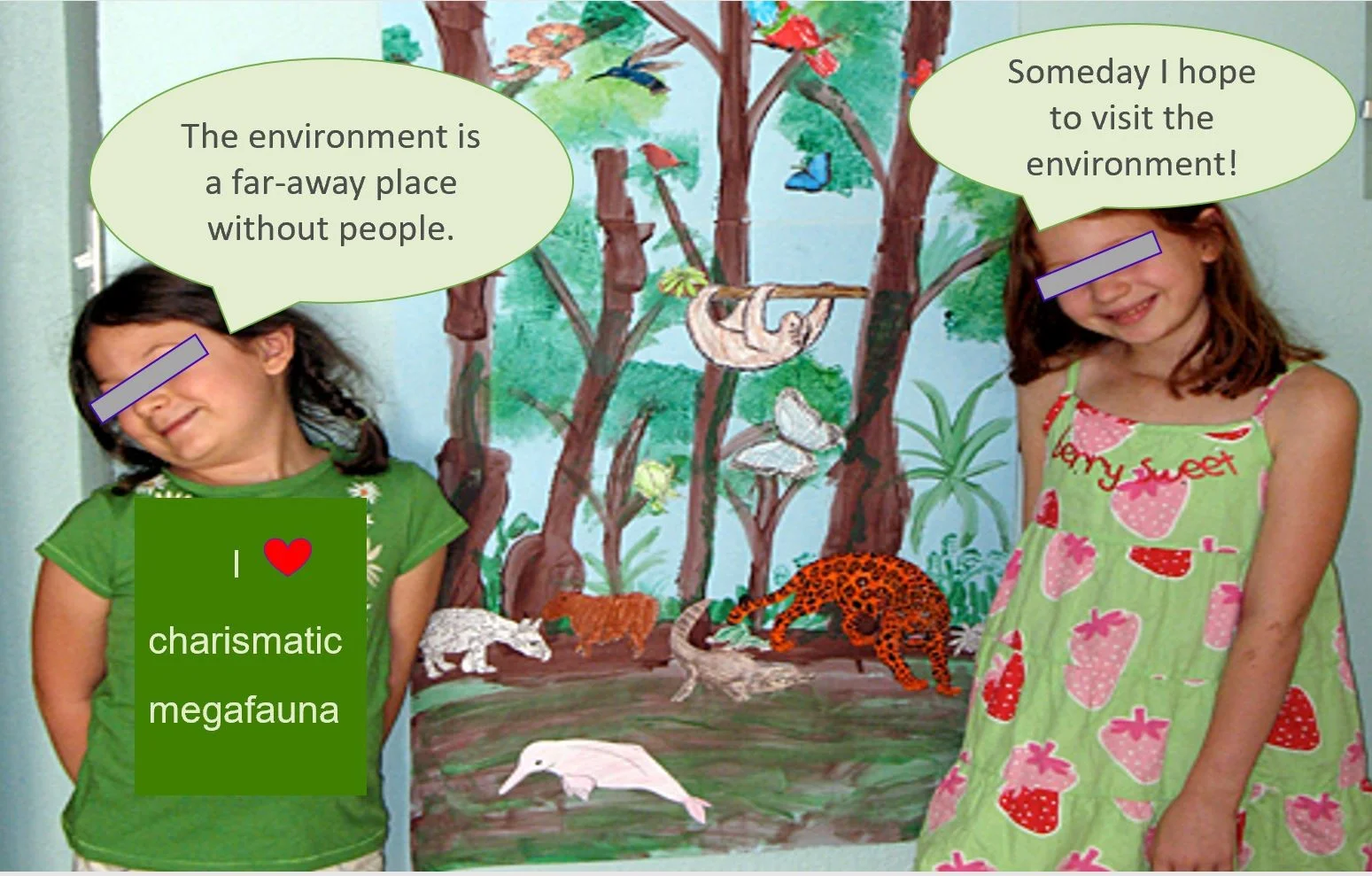
Earth Day is here again, and kids around the country may well be busy making endangered species posters or constructing a paper mache rainforest. Such projects—mainstays of what I call Environmental Ed Lite—can be fun. But focusing on exotic animals and ‘wild’ places sends the message that the environment is a place both far away and without people. That keeps kids from understanding a vital and basic scientific fact: humans are part of the environment.

“Green” learning that prioritizes stereotypical topics such as rainforests and endangered species—however important—doesn’t advance the more complex critical thinking and civic engagement goals of sustainability literacy. Can the student who draws a rainforest toucan identify a bird that’s native to the local ecosystem? Can the student who made an Amazonian kapok tree name an indigenous tribe that inhabits the forest? I wonder. Perhaps most significant, presenting the environment as external to students can inadvertently reinforce the idea that the natural world is at our disposal—an anthropocentric mindset that is not innate but learned.

Place-based Education

How can we change the story? One approach is place-based education (PBE). PBE situates environmental literacy in the actual places students inhabit, making the community the starting point for investigating environmental, cultural, political, and social phenomena. PBE views the world as it truly is—a system—by using local environment conditions, cultural perspectives, and historical events to teach concepts in practically any discipline. PBE can happen inside, outside, or both.

Place-based education is not simply about (for example) interviewing local residents as a point of interest. Rather, PBE cultivates students’ identities as members of ecological and civic communities with a shared stake in common issues. PBE fosters students’ capacity to solve real problems, and used as the basis for project-based learning, PBE provides immediate relevance. Because students engage with issues right outside their doors, they naturally raise questions complex enough to support meaningful projects.

For example, in a rural community in Oregon, students in an interdisciplinary STEM course focused on the redevelopment of a “brownfield” (a contaminated site) located on school property. Working with state and local agencies, students investigated the history of the site, soil and water quality, and associated health risks. As a final project, students created redevelopment proposals and presented them at a state brownfields conference. In addition to impressive academic gains, the course also provided student exposure to career pathways in STEM, law, public policy, and more.

Global learning starts at home

Place-based education doesn’t discard a global perspective, but rather gets there by starting at home. For example, to bridge local ecosystems and the Brazilian rainforest, students might compare the two ecosystems and (as age-appropriate) learn about indigenous tribes, the impacts of industrialization, revitalization movements, and ways our own consumption habits affect it all. Including social justice themes ensures that place-based education doesn’t neglect—or even reinforces—colonial mindsets by remaining silent on the cultural or ecological ramifications of “development.”

Is it time to clear-cut the paper mache rainforest? Not necessarily. But let’s raise the bar. Environmental literacy is an essential 21st century skill that will determine life in the 22nd century. Our kids deserve the best we can give them.

You can learn more about place-based education in my book, Reframing the Curriculum.


In sustainability, education
← Equity and Equality: What's the difference?Social Justice: It's democratic (small d), not Democratic →

Latest Posts

Featured
democratic not Democratic (2).jpg
July 10, 2024
Diversity, Equity, Inclusion and Social Justice Blogs: Quick Links
July 10, 2024

Find my collection of blogs on equity and social justice here.

Read more →
July 10, 2024
Neoliberalism in Education: What you need to know
May 21, 2024
Neoliberalism in Education: What you need to know
May 21, 2024
Read more →
May 21, 2024
Indigenous Language & Values in the Classroom + Home
August 10, 2023
Indigenous Language & Values in the Classroom + Home
August 10, 2023
Read more →
August 10, 2023
Banned Books and Free Speech in Schools: Tips for Teachers, Authors, and Readers
August 5, 2022
Banned Books and Free Speech in Schools: Tips for Teachers, Authors, and Readers
August 5, 2022

Banned books, censorship, and other assaults on free speech in school. What’s a teacher or author to do? In this blog, I discuss two defining legal cases on the topic and offer strategies for defending challenged content.

Read more →
August 5, 2022
How can we improve civic dialog and heal divisions?
July 9, 2022
How can we improve civic dialog and heal divisions?
July 9, 2022

The hard work of becoming informed citizens is a dying art, but we can revive it. The health of our democracy depends on it. Effective dialog is the foundation.


Read more →
July 9, 2022
The Pseudoscience Driving Hate
May 28, 2022
The Pseudoscience Driving Hate
May 28, 2022

While the physical differences we associate with race are real, there is no single “race gene.” Nonetheless, the idea persists, resting upon a troubling yet often hidden history of misusing science to justify social-constructed racial hierarchies.

Read more →
May 28, 2022
New Podcast Episodes
February 28, 2022
New Podcast Episodes
February 28, 2022

What’s more fun than listening to podcasts? Being a guest on one.

I recently had the opportunity to be interviewed on two educational podcasts on the following shows. I hope you’ll take a listen.

Read more →
February 28, 2022
Critical Race Theory and the Race to Silence Teachers
February 8, 2022
Critical Race Theory and the Race to Silence Teachers
February 8, 2022

With the new school year upon us, a growing number of states are in overdrive to ban honest teaching about race, with fears of Critical Race Theory as a flagship motivation. In this post, I dig into the controversy, expose hypocrisy, and share the analysis created by my students at the University of Michigan.

Read more →
February 8, 2022
Yes, you can teach about religion during the holiday season
December 10, 2021
Yes, you can teach about religion during the holiday season
December 10, 2021

It’s December, and that means K-12 students and their families will be celebrating Hannukah, Christmas, and other religious holidays. It also means that school officials wonder if they can discuss religious beliefs, display related decorations, or include sacred music in holiday concernts. This blog offers some answers.

Read more →
December 10, 2021
Economic Growth Fails the Science Test
November 2, 2021
Economic Growth Fails the Science Test
November 2, 2021

Growth is the sacred cow of economic policy, a goal fueled by this unquestioned premise: Unlimited growth is both desirable (because it’s always beneficial) and possible (because nothing can contain human ambitions). It’s an alluring narrative. But do the storytellers realize they’re spinning science fiction?

Read more →
November 2, 2021

Contact


© Susan Santone